
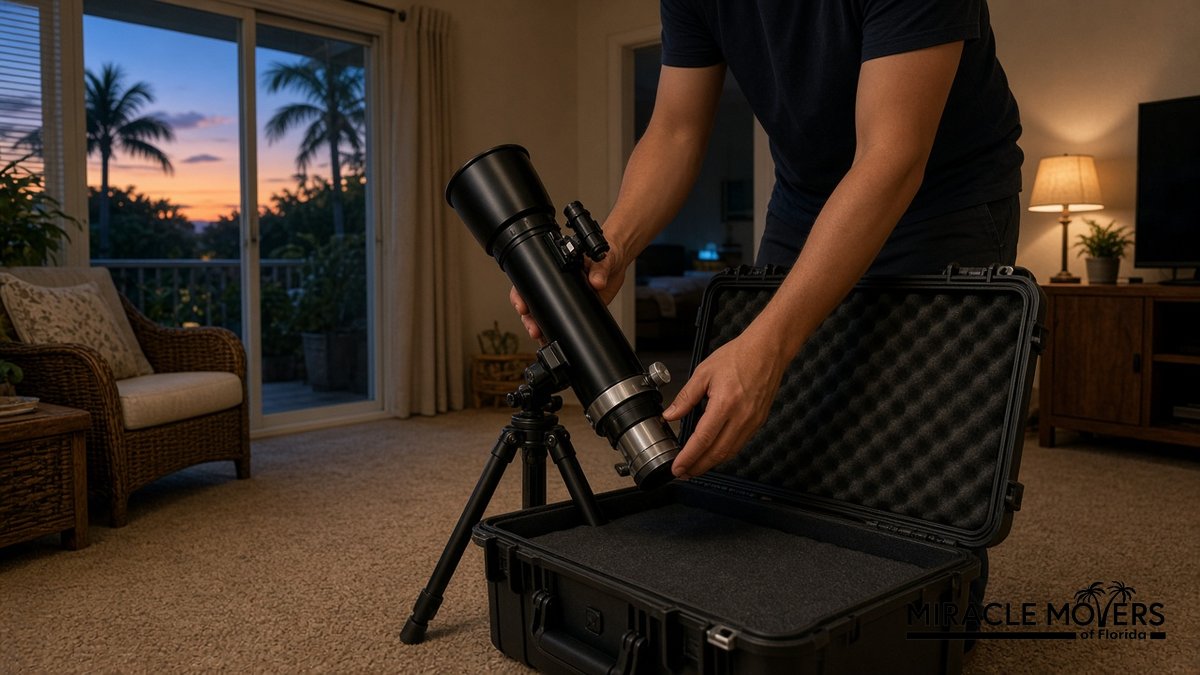
Moving a home telescope is a small-parts job bolted to a heavy one. The mount can weigh as much as a bulky piece of furniture, and the optical tube is easier to knock out of alignment than it looks. Eyepieces, a diagonal, and a handful of thumbscrews disappear into a silverware box if they are not bagged first. Backyard setups are common on the Space Coast, from a simple tripod in Cape Canaveral to a heavier equatorial mount in a spare room. The move goes better when the scope is already broken into the pieces it was designed to travel in.
Taking the mount apart before moving a home telescope
Take the optical tube off the mount before moving day. Do not carry the whole assembly by the tube, and do not lift it by the finder scope. Cap both ends. Use the case if you have one. If you do not, a snug box with padding at both ends is the next best thing. Support the tube along its length. A long tube bridging a gap in a stack can take a bend you will not see until the next clear night.
Remove counterweights and pack them in their own small, strong box marked heavy, so nobody stacks it on a lamp. A single piece of low-tack tape on the counterweight shaft can mark a balance position. Do not put tape on lenses, mirrors, or a corrected plate. Collapse the tripod, secure the straps, and wrap the feet so they do not scar a floor.
Measure the mount and tripod against the doorway, especially if the mount head does not come off easily. The checks in what to measure before moving day cover those turns. A concrete pier is not cargo.
Small optics and the hardware bag
Eyepieces, Barlow lenses, a diagonal, and filters belong in their own case, caps on. Do not toss them in a drawer with coins. Finder scopes and red-dot sights should come off if they snag, with their screws in a labeled bag. That bag is the difference between a scope you can set up next week and one that sits in the corner. Use the same habit described in packing tools and small parts. One bag per mount, taped shut. Coil and bag cables for a powered mount. The crew can move the cases. They will not trace a wiring diagram at the new house.
Humidity and the room it lands in
Cap the optics and do not pack a wet tube. Dew is normal here. A soaked case closed up in a warm truck lets moisture sit on glass. If you already keep silica packs in the case, leave them in. Say if a mirror needs to stay upright in its cell. If the manufacturer says so, that can be followed, but it has to be known before the tube is sideways in a closet box.
Do not leave the scope in a shed or an open carport while you sort the rest of the house. Name the room. A simple floor plan for moving day can say “spare room, telescope cases, not the garage.” That line keeps a mount out of damp air.
- Tube off the mount, capped, and in a case or a fitted box.
- Counterweights out, in a small heavy box.
- Eyepieces and small hardware bagged and labeled.
- A named room that is not the main walkway.
Keep other hobby boxes separate so a glue bottle never shares a carton with an eyepiece. The crew places the cases. Alignment is yours after they leave.
Miracle Movers of Florida offers packing, local moving, and long-distance moving from Cape Canaveral. Mention a telescope with the other heavy or fragile pieces so it is not packed under the sofa.
Call (407) 819-0886 and describe the mount and tube before moving day.